
Author: enlightenedcenter
Proficiency Diploma in Digital Marketing and E-Commerce
Proficiency Diploma in Digital Marketing and E-Commerce
Course Duration: 4 to 6 Months (16 to 24 weeks) Course Fee: 30,000 Kenyan Shillings Weekly Commitment: Minimum of 2 hours per day Course Overview: This comprehensive diploma course equips students with advanced skills in digital marketing and e-commerce. It covers a broad range of topics including advanced SEO, content marketing, social media strategies, PPC advertising, analytics, and e-commerce management. The course also emphasizes hands-on projects to develop practical expertise.Course Outline
Semester 1: Foundations of Digital Marketing and E-Commerce Week 1-4: Advanced Digital Marketing Strategies- Understanding Digital Marketing Trends and Best Practices
- In-Depth Analysis of Digital Marketing Channels
- Integrated Marketing Communications (IMC) in the Digital Age
- Practical Exercises: Developing a digital marketing strategy
- Advanced Keyword Research and Competitive Analysis
- Technical SEO and Site Architecture
- Local SEO Strategies and Tools
- Practical Exercises: Conducting an SEO audit and optimization
- Building and Managing a Social Media Strategy
- Leveraging Influencer Marketing for Brand Growth
- Measuring Social Media ROI and Analytics
- Practical Exercises: Crafting a social media and influencer campaign
- Advanced Content Strategy and Creation Techniques
- Storytelling for Brands in the Digital Space
- Repurposing Content Across Multiple Platforms
- Practical Exercises: Developing a content marketing campaign
- Setting Up and Managing Advanced E-Commerce Platforms (e.g., Magento, BigCommerce)
- Customizing E-Commerce Sites for User Experience (UX)
- Managing Online Payments, Security, and Compliance
- Practical Exercises: Building an e-commerce site with advanced features
- Advanced PPC Strategies for Google Ads and Social Media
- Creating Effective Retargeting Campaigns
- Budgeting and Bidding Strategies for Maximum ROI
- Practical Exercises: Running a complex PPC campaign
- Using Google Analytics for E-Commerce Insights
- Conversion Rate Optimization (CRO) Techniques
- A/B Testing and Multivariate Testing
- Practical Exercises: Analyzing data and optimizing conversion rates
- Developing a Comprehensive Digital Marketing and E-Commerce Plan
- Presenting the Capstone Project to a Panel of Experts
- Building a Professional Portfolio and Career Planning
- Practical Exercises: Final project presentation and portfolio review
Proficiency Certificate in Digital Marketing and E-Commerce
Proficiency Certificate in Digital Marketing and E-Commerce
Course Duration: 3 to 4 Months (12 to 16 weeks) Course Fee: 15,000 Kenyan Shillings Weekly Commitment: Minimum of 2 hours per day Course Overview: This course provides students with the foundational skills and knowledge necessary to excel in digital marketing and e-commerce. It covers key aspects such as online marketing strategies, social media marketing, search engine optimization (SEO), pay-per-click (PPC) advertising, email marketing, and e-commerce platforms.Course Outline
Week 1-2: Introduction to Digital Marketing- Overview of Digital Marketing Concepts
- Understanding the Digital Marketing Funnel
- Key Performance Indicators (KPIs) and Metrics
- Practical Exercises: Setting up a basic digital marketing plan
- Basics of SEO and Search Engine Algorithms
- Keyword Research and On-Page SEO Techniques
- Off-Page SEO and Link Building Strategies
- Practical Exercises: Optimizing a website for search engines
- Overview of Social Media Platforms (Facebook, Instagram, LinkedIn, etc.)
- Creating Engaging Social Media Content
- Social Media Advertising and Analytics
- Practical Exercises: Developing a social media campaign
- Introduction to PPC Advertising (Google Ads, Bing Ads)
- Setting Up and Managing PPC Campaigns
- Optimizing Ad Performance and ROI
- Practical Exercises: Creating and managing a PPC campaign
- Basics of Email Marketing and List Building
- Creating Effective Email Campaigns
- Analyzing Email Campaign Performance
- Practical Exercises: Designing an email marketing campaign
- Introduction to E-Commerce and Online Business Models
- Setting Up and Managing E-Commerce Platforms (Shopify, WooCommerce)
- Payment Gateways and Security Considerations
- Practical Exercises: Building an e-commerce website
- Content Strategy and Planning
- Writing Persuasive Copy for Digital Marketing
- Using Blogs, Videos, and Podcasts for Marketing
- Practical Exercises: Creating content for a digital marketing campaign
- Review of Key Concepts and Techniques
- Practical Assessment: Developing a comprehensive digital marketing and e-commerce strategy
- Final Exam Preparation and Certification
- Course Wrap-Up and Evaluation
PROFICIENCY CERTIFICATE IN COMPUTERIZED SECRETARIAL STUDIES and FRONT OFFICE
PROFICIENCY CERTIFICATE IN COMPUTERIZED SECRETARIAL STUDIES
Course Duration: 2 to 3 months (8 to 12 weeks)
Course Fee: 15,000 Kenyan Shillings
Course Overview:
This certificate course provides essential training in computerized secretarial tasks, focusing on office management, document processing, and business communication. It is designed to equip students with the skills needed for entry-level administrative roles.
Week 1-2: Introduction to Secretarial Studies
- Overview of Secretarial Roles
- Responsibilities and Skills of a Secretary
- Professionalism and Workplace Etiquette
- Office Environment and Equipment
- Understanding Basic Office Equipment
- Efficient Use of Office Tools
Week 3-4: Advanced Computer Applications
- Word Processing
- Creating and Formatting Documents (Microsoft Word)
- Using Templates and Styles
- Spreadsheet Management
- Basic Excel Functions and Formulas
- Data Entry and Simple Analysis
- Presentation Software
- Creating and Designing Presentations (Microsoft PowerPoint)
- Effective Presentation Techniques
Week 5-6: Business Communication and Documentation
- Effective Communication Skills
- Writing Professional Business Correspondence (Letters, Emails)
- Telephone Etiquette and Customer Interaction
- Document Management
- Creating and Managing Professional Documents
- Proofreading and Editing Techniques
Week 7-8: Office Management Essentials
- Basic Office Procedures
- Managing Office Supplies and Inventory
- Scheduling and Coordinating Meetings
- Practical Exercises
- Hands-On Practice with Real-World Scenarios
- Role-Playing Administrative Tasks
Week 9-10: Final Assessment and Review
- Capstone Project (Optional)
- Implementing a Basic Office Management Task or Project
- Review and Exam Preparation
- Comprehensive Review of Course Content
- Practice Exercises and Mock Exams
- Final Exam
- Written and Practical Assessments
Certification
Upon successful completion of the course, students will receive a "Proficiency Certificate in Computerized Secretarial Studies," demonstrating their capability in essential secretarial skills and office management. This qualification prepares students for entry-level administrative and secretarial positions.
computer application packages certificate
PROFICIENCY CERTIFICATE IN COMPUTER APPLICATION PACKAGES
Course Duration: 8 to 12 weeks (2 to 3 months)
Course Fee: 15,000 Kenyan Shillings
Weekly Commitment: Minimum of 2 hours per day
Course Overview:
This course provides comprehensive training in advanced features and functionalities of key computer application packages, including word processing, spreadsheets, presentations, and database management.
Week 1-2: Word Processing (Microsoft Word or Google Docs)
- Document Formatting and Layout
- Advanced Styles and Themes
- Customizing Headers, Footers, and Page Numbers
- Working with Sections and Columns
- Advanced Editing and Review Tools
- Track Changes and Comments
- Using Templates and Macros
- Managing Large Documents (Table of Contents, Indexing)
- Practical Exercises: Creating and formatting professional reports, research papers, and complex documents
Week 3-4: Spreadsheet Management (Microsoft Excel or Google Sheets)
- Complex Formulas and Functions
- Advanced Mathematical, Statistical, and Logical Functions
- Nested Functions and Conditional Formatting
- Data Analysis Tools
- Pivot Tables and Pivot Charts
- Data Validation and Consolidation
- Using Solver and What-If Analysis Tools
- Practical Exercises: Performing data analysis, creating dynamic reports, and automating tasks using macros
Week 5-6: Presentation Techniques (Microsoft PowerPoint or Google Slides)
- Designing Engaging Presentations
- Custom Themes and Templates
- Using Advanced Animation and Transition Effects
- Incorporating Multimedia (Audio, Video, and Graphics)
- Collaborative Features and Presentation Tools
- Working with Comments and Real-Time Collaboration
- Integrating with Other Applications (Excel, Word)
- Delivering and Timing Presentations
- Practical Exercises: Developing professional presentations with advanced features for business or educational purposes
Week 7-8: Database Management (Microsoft Access or Google Sheets/Forms)
- Database Fundamentals
- Designing Database Schemas and Tables
- Setting Up Relationships and Keys
- Using Queries to Retrieve Data
- Advanced Database Features
- Creating and Customizing Forms and Reports
- Automating Tasks with Macros
- Managing and Securing Data
- Practical Exercises: Creating and managing databases for different use cases, generating reports, and automating data entry
Week 9-10: Integrated Office Applications
- Integrating Applications
- Linking Data Between Word, Excel, PowerPoint, and Access
- Embedding and Importing Data Across Applications
- Using Mail Merge and Other Automation Tools
- Customizing and Automating Office Environments
- Using Macros Across Applications
- Customizing Ribbons and Quick Access Toolbars
- Advanced Printing and Exporting Options
- Practical Exercises: Creating integrated projects that utilize multiple application packages for comprehensive business solutions
Week 11-12: Capstone Project and Professional Development
- Capstone Project
- Design and Develop a Comprehensive Project Using Multiple Application Packages
- Apply Advanced Features and Integration Techniques
- Project Presentation and Evaluation
- Career Development
- Building a Portfolio of Advanced Computer Application Projects
- Job Search Strategies and Networking in Administrative and IT Roles
- Exploring Further Learning and Certification Opportunities
Final Week: Course Review and Assessment
- Comprehensive Review
- Review of Key Concepts and Skills
- Final Assessment
- Written and Practical Evaluation Based on the Capstone Project and Course Content
Certification
Upon successful completion of the course, students will receive a "Proficiency Certificate in Advanced Computer Application Packages," recognizing their ability to use advanced features in key software applications for professional and business purposes.
Basic Computer packages
Course Overview: Computer systems are now relied on for a broad spectrum of duties, including bookkeeping, business communications, product design, manufacturing, inventory control, and marketing.
This Course equips students with a thorough computer skills, knowledge of database systems, spreadsheets, PC troubleshooting and computer networking essentials.
The emphasis of this study is for students to be proficient in computers and skills that are important for academic, personal, and job success.
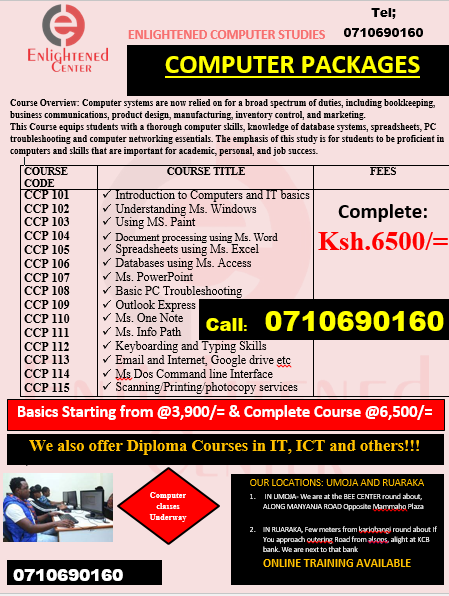
Fee Structure Breakdown for basic Computer packages
Description |
Amount (KES) |
Registration Fee and student ID |
600 |
Tuition Fee |
3900 |
Examination and Assessment Fee |
1000 |
Computer and Resource Fee |
500 |
Caution/Lab and Software Fee |
500 |
Total |
6500 |
The Proficiency certificate takes 1 to 2 months
Payment Schedule options:
Option
1: Full Payment Option
2: Installment Plan (2 or 3 Payment Installments)
Our Programs
We offer ICT AND computer Courses. Both basic and Advanced levels.
We have courses for Computer beginners and those who wish to take advanced certificate and Diploma levels.










Basic Courses
1. PROFICIENCY CERTIFICATE IN BASIC COMPUTER APPLICATION PACKAGES
2. PROFICIENCY CERTIFICATE IN GRAPHIC DESIGN
3. PROFICIENCY CERTIFICATE IN WEB DESIGN AND DEVELOPMENT
4. PROFICIENCY CERTIFICATE IN PROGRAMMING AND SOFTWARE ENGINEERING
5. PROFICIENCY CERTIFICATE IN DIGITAL MARKETING
6. PROFICIENCY CERTIFICATE IN COMPUTERIZED ACCOUNTING
8. PROFICIENCY CERTIFICATE IN STATISTICAL PACKAGES
9. PROFICIENCY CERTIFICATE IN IT SECURITY AND ETHICAL HACKING
10.PROFICIENCY CERTIFICATE IN ANIMATION AND MULTIMEDIA
11. PROFICIENCY CERTIFICATE IN MOBILE APPLICATION DEVELOPMENT
12.PROFICIENCY CERTIFICATE IN COMPUTER NETWORKING
13. PROFICIENCY CERTIFICATE IN PC SUPPORT AND MAINTENANCE
-
PROFICIENCY CERTIFICATE IN COMPUTER AIDED GRAPHIC DESIGN
-
PROFICIENCY CERTIFICATE IN INFORMATION COMMUNICATION TECHNOLOGY (ICT)
-
PROFICIENCY CERTIFICATE IN BUSINESS INFORMATION TECHNOLOGY (BIT)
-
PROFICIENCY CERTIFICATE IN CCTV AND ALARM SYSTEMS INSTALLATION
PROFICIENCY DIPLOMA COURSES
3. PROFICIENCY DIPLOMA IN WEB DESIGN AND DEVELOPMENT
4. PROFICIENCY DIPLOMA IN PROGRAMMING AND SOFTWARE ENGINEERING
5. PROFICIENCY DIPLOMA IN DIGITAL MARKETING
6. PROFICIENCY DIPLOMA IN COMPUTERIZED ACCOUNTING
7.PROFICIENCY DIPLOMA IN SECRETARIAL STUDIES / FRONT OFFICE
8. PROFICIENCY DIPLOMA IN STATISTICAL PACKAGES
9. PROFICIENCY DIPLOMA IN IT SECURITY AND ETHICAL HACKING
10.PROFICIENCY DIPLOMA IN ANIMATION AND MULTIMEDIA
11. PROFICIENCY DIPLOMA IN MOBILE APPLICATION DEVELOPMENT
12.COMPUTER NETWORKS AND SYSTEMS ADMINISTRATION
13. PROFICIENCY DIPLOMA IN PC SUPPORT AND MAINTENANCE
-
PROFICIENCY DIPLOMA IN CCTV AND ALARM SYSTEMS INSTALLATION
19.COMPUTERISED ACCOUNTING
.20.DIGITAL MEDIA AND VIDEO EDITING</span
21.CCTV AND ALARM SYSTEMS INSTALLATION
22.INFORMATION TECHNOLOGY
22.DIGITAL MARKETING
23.ELECTRONIC REPAIR
24.COMPUTER AIDED DESIGN
25.PROFICIENCY IN MS WORD
26.PROFICIENCY IN MS PUBLISHER
27.PROFICIENCY COURSE IN MS ACCESS
29.PROFICIENCY COURSE IN MS POWERPOINT
30.PROFICIENCY IN MOBILE APPLICATION DEVELOPMENT
2-Year Diploma in Virtual and Augmented Reality Development
2-Year Diploma in Virtual and Augmented Reality Development
Course Duration: 2 Years (4 Semesters, including holidays and attachment)Course Fee: 30,000 Kenyan Shillings per semester
Weekly Commitment: Minimum of 2 hours per day
Course Overview: This diploma program focuses on developing the skills necessary for creating and managing virtual reality (VR) and augmented reality (AR) applications. The curriculum covers VR/AR development, 3D modeling, user experience design, and project management, preparing students for careers in VR/AR development and related fields.
Year 1
Semester 1: Introduction to VR/AR Development Week 1-4: Fundamentals of VR/AR- Introduction to Virtual and Augmented Reality
- History and Evolution of VR/AR Technologies
- VR/AR Hardware and Software Overview
- Practical Exercises: Basic VR/AR application setup
- Overview of Development Tools (e.g., Unity, Unreal Engine)
- Setting Up Development Environments
- Introduction to VR/AR SDKs (e.g., ARKit, ARCore)
- Practical Exercises: Developing simple VR/AR applications
- Basics of 3D Modeling
- Introduction to 3D Animation
- Tools for 3D Modeling and Animation (e.g., Blender, Maya)
- Practical Exercises: Creating 3D models and animations
- Principles of UX Design in VR/AR
- Designing Intuitive VR/AR Interfaces
- User Testing and Feedback in VR/AR
- Practical Exercises: Designing and testing VR/AR interfaces
Semester 2: Intermediate VR/AR Development Week 1-4: Advanced VR/AR Development Techniques
- Advanced Features in VR/AR Development Tools
- Optimizing VR/AR Applications for Performance
- Integrating 3D Models into VR/AR Applications
- Practical Exercises: Developing complex VR/AR applications
- Creating Interactive VR/AR Experiences
- Implementing User Interactions in VR/AR
- Using Sensors and Controllers in VR/AR
- Practical Exercises: Building interactive VR/AR applications
- Game Design Principles for VR/AR
- Developing VR/AR Games
- Case Studies of Successful VR/AR Games
- Practical Exercises: Creating a VR/AR game prototype
- Applications of VR/AR in Education
- Developing Educational VR/AR Content
- Case Studies of VR/AR in Training and Education
- Practical Exercises: Developing educational VR/AR applications
Year 2
Semester 3: Advanced VR/AR Applications Week 1-4: VR/AR for Healthcare and Therapy- Applications of VR/AR in Healthcare
- Developing Therapeutic VR/AR Applications
- Case Studies of VR/AR in Healthcare
- Practical Exercises: Creating a healthcare-focused VR/AR application
- VR/AR Applications in Architecture
- Developing Real Estate VR/AR Tours
- Case Studies of VR/AR in Architecture
- Practical Exercises: Building a VR/AR real estate tour
- VR/AR in Marketing Strategies
- Developing VR/AR Marketing Campaigns
- Case Studies of VR/AR in Advertising
- Practical Exercises: Creating a VR/AR marketing application
- Planning and Managing VR/AR Projects
- Agile Methodologies for VR/AR Development
- Stakeholder Engagement and Communication
- Practical Exercises: Managing a VR/AR project
Semester 4: Capstone Project and Industry Attachment Week 1-4: Capstone Project
- Identifying a Real-World VR/AR Challenge
- Project Planning, Design, and Implementation
- Presentation and Evaluation of Capstone Project
- Final Assessment
- Hands-On Experience in VR/AR Development Roles
- Applying Learned Skills in Real-World VR/AR Environments
- Industry Networking and Professional Development
- Building a Professional Portfolio and Resume
- Job Search Strategies and Interview Preparation
- Understanding Industry Certifications (e.g., Unity Certified Developer)
- Comprehensive Review of All Topics Covered
- Practice Projects and Final Assessments
- Final Exam and Evaluation
Certification: Upon successful completion of the course, students will receive a "Diploma in Virtual and Augmented Reality Development," certifying their proficiency in developing, managing, and optimizing VR/AR applications for various platforms. This certification prepares them for roles such as VR/AR Developer, 3D Modeler, UX Designer, and Project Manager in the VR/AR industry
2-Year Diploma in Applied Cryptography and Security
2-Year Diploma in Applied Cryptography and Security
Course Duration: 2 Years (4 Semesters, including holidays and attachment)
Course Fee: 30,000 Kenyan Shillings per semester
Weekly Commitment: Minimum of 2 hours per day
Course Overview:
This diploma provides an in-depth understanding of cryptographic principles, security protocols, and their applications in securing information systems. Students will learn about encryption algorithms, cryptanalysis, secure communication, and the implementation of security measures in various digital environments.
Year 1
Semester 1: Foundations of Cryptography
Week 1-4: Introduction to Cryptography
- History and Evolution of Cryptography
- Basic Concepts: Encryption, Decryption, and Keys
- Types of Cryptography: Symmetric and Asymmetric
- Practical Exercises: Implementing basic encryption algorithms
Week 5-8: Number Theory and Algebra for Cryptography
- Modular Arithmetic and Number Theory Basics
- Prime Numbers and Factorization
- Algebraic Structures in Cryptography
- Practical Exercises: Solving cryptographic problems using number theory
Week 9-12: Symmetric Cryptography
- Block Ciphers and Stream Ciphers
- Data Encryption Standard (DES) and Advanced Encryption Standard (AES)
- Key Management and Distribution
- Practical Exercises: Implementing and analyzing symmetric encryption algorithms
Week 13-16: Asymmetric Cryptography
- Public Key Infrastructure (PKI)
- RSA, Diffie-Hellman, and Elliptic Curve Cryptography (ECC)
- Digital Signatures and Certificates
- Practical Exercises: Implementing and analyzing asymmetric encryption algorithms
Semester 2: Cryptographic Protocols and Applications
Week 1-4: Secure Communication Protocols
- SSL/TLS and HTTPS
- VPNs and Secure Tunneling Protocols
- Cryptographic Handshakes and Key Exchange
- Practical Exercises: Configuring secure communication channels
Week 5-8: Authentication and Authorization
- Password Security and Hash Functions
- Multi-Factor Authentication (MFA)
- Role-Based Access Control (RBAC) and Identity Management
- Practical Exercises: Implementing authentication mechanisms in systems
Week 9-12: Cryptanalysis and Attack Strategies
- Types of Cryptanalytic Attacks (Brute Force, Side-Channel)
- Analyzing Weaknesses in Cryptographic Systems
- Defensive Measures and Mitigation Strategies
- Practical Exercises: Performing cryptanalysis on sample cryptographic systems
Week 13-16: Applied Cryptography in Systems
- Cryptography in Cloud Computing and IoT
- Blockchain and Cryptocurrencies
- Secure Software Development Practices
- Practical Exercises: Applying cryptography to secure various systems
Year 2
Semester 3: Advanced Topics in Cryptography and Security
Week 1-4: Quantum Cryptography
- Principles of Quantum Computing and its Impact on Cryptography
- Quantum Key Distribution (QKD)
- Post-Quantum Cryptography
- Practical Exercises: Exploring quantum-resistant cryptographic algorithms
Week 5-8: Cryptographic Applications in Real-World Systems
- Secure Email (PGP, S/MIME)
- Cryptographic Applications in Payment Systems and Banking
- Digital Rights Management (DRM) and Intellectual Property Protection
- Practical Exercises: Implementing cryptography in real-world scenarios
Week 9-12: Security Protocols and Network Security
- Network Security Protocols (IPSec, SSH)
- Wireless Security (WPA3, WEP)
- Firewalls, Intrusion Detection, and Prevention Systems
- Practical Exercises: Configuring and securing network infrastructure
Week 13-16: Security Compliance and Standards
- International Standards (ISO/IEC 27001)
- Regulatory Compliance (GDPR, HIPAA)
- Auditing and Risk Management in Security
- Practical Exercises: Conducting security audits and ensuring compliance
Semester 4: Capstone Project and Industry Attachment
Week 1-4: Capstone Project
- Identifying a Problem Statement in Cryptography or Security
- Project Planning, Research, and Development
- Implementation, Testing, and Documentation
- Final Presentation and Evaluation
Week 5-8: Industry Attachment
- Hands-On Experience in Security and Cryptography Roles
- Applying Learned Skills in Real-World Security Projects
- Industry Networking and Professional Development
Week 9-12: Professional Development and Career Planning
- Building a Professional Portfolio and Resume
- Job Search Strategies and Interview Preparation
- Understanding Industry Certifications (CISSP, CEH) and Pathways
Week 13-16: Course Review and Final Exam
- Comprehensive Review of All Topics Covered
- Practice Projects and Final Assessments
- Final Exam and Evaluation
Certification:
Upon successful completion of the course, students will receive a "Diploma in Applied Cryptography and Security," certifying their expertise in cryptographic principles, secure system design, and cybersecurity protocols. This certification prepares them for roles such as Cryptographer, Security Analyst, Network Security Engineer, and similar positions in cybersecurity and cryptography.